America's Green Carpet Problem: The Climate Toll of Turf Grass and the Native Plants That Can Replace It
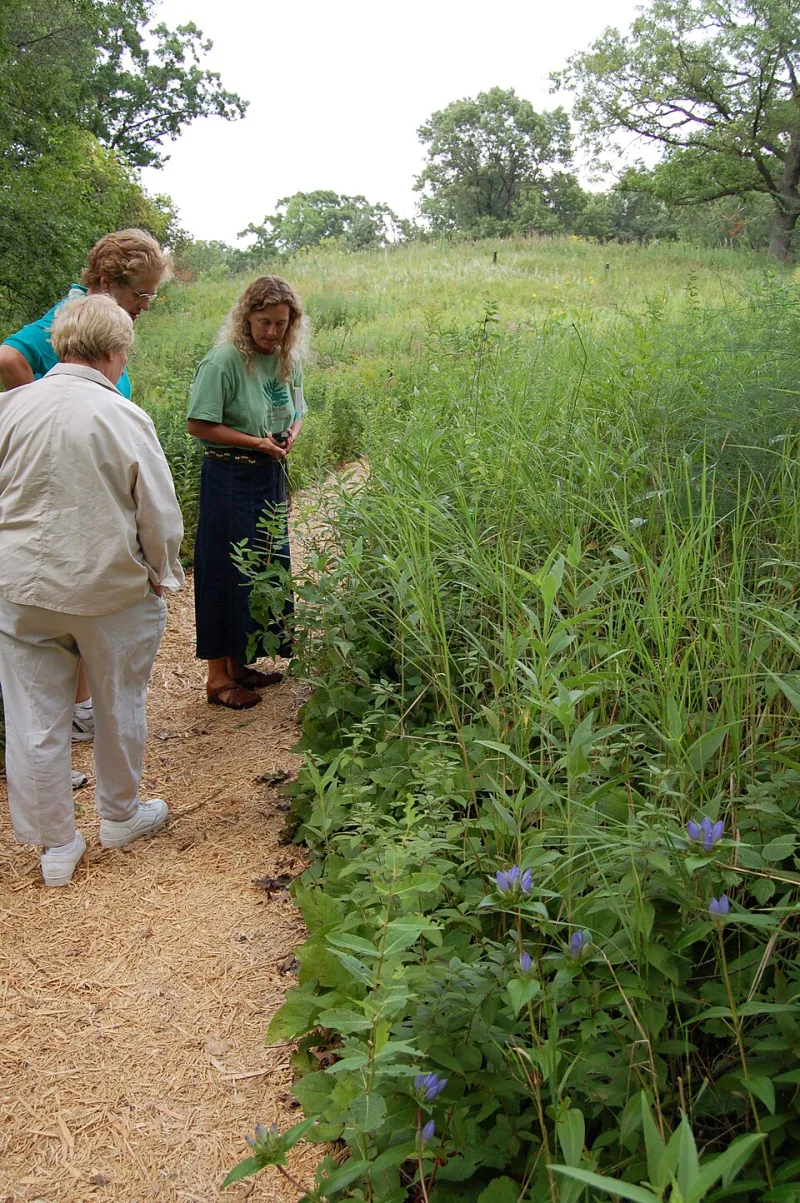
Photo: A. E. Crane, U.S. Department of Transportation, Public domain, via Wikimedia Commons
For generations, a thick, uniformly green lawn has served as a quiet symbol of American prosperity. Homeowners seed, fertilize, water, and mow with near-religious devotion, and neighborhood associations enforce conformity with the zeal of aesthetic arbiters. Yet beneath that tidy surface lies an environmental accounting that rarely appears on any household budget: a running tally of carbon emissions, chemical runoff, depleted aquifers, and lost biodiversity that collectively places the American lawn among the country's most underappreciated contributors to climate change.
At Green String Institute, we believe that genuine sustainability begins at home—sometimes quite literally. Understanding what your lawn actually costs the planet is the first step toward making choices that are better for your community, your region's ecology, and the global climate system.
The Numbers Behind the Grass
Turf grass is, by acreage, the single largest irrigated crop in the United States. NASA satellite data estimates that American lawns cover approximately 40 million acres—an area larger than the state of Georgia. That figure alone is striking, but the resource demands attached to maintaining those acres are what make the picture genuinely alarming.
Gas-powered lawn mowers are among the most polluting small engines in common civilian use. The U.S. Environmental Protection Agency has estimated that operating a conventional gasoline mower for one hour produces roughly the same volume of volatile organic compounds and nitrogen oxides as driving a car approximately 45 miles. Across an entire mowing season, the collective emissions from residential lawn equipment in the U.S. account for an estimated 5 percent of the nation's total air pollution—a figure that surprises most homeowners who have never considered their Saturday chores in those terms.
Fertilizer represents a second major liability. Synthetic nitrogen fertilizers, widely applied to maintain that deep green color, are manufactured through the Haber-Bosch process, which is extraordinarily energy-intensive and heavily dependent on natural gas. When these fertilizers are applied to lawns, a significant portion is not absorbed by grass roots. Instead, it volatilizes into the atmosphere as nitrous oxide—a greenhouse gas approximately 273 times more potent than carbon dioxide over a 100-year timeframe—or washes into stormwater systems, contributing to algal blooms and aquatic dead zones in rivers, estuaries, and coastal waters.
Water consumption completes the troubling portrait. Residential outdoor water use, dominated by lawn irrigation, accounts for nearly one-third of all residential water consumption in the U.S., totaling approximately 9 billion gallons per day according to EPA estimates. In drought-prone regions such as the Southwest and Great Plains, this demand places extraordinary stress on already-strained aquifer systems.
The Biodiversity Deficit
Beyond direct emissions and resource consumption, conventional lawns impose a less-visible but equally consequential ecological cost: the displacement of native plant communities. Turf grass monocultures offer minimal habitat value for pollinators, birds, or soil organisms. A mowed lawn of Kentucky bluegrass or Bermuda grass supports a fraction of the insect species that a comparable area of native meadow or woodland understory would sustain.
Entomologist Doug Tallamy's research at the University of Delaware has documented that native oak trees alone support over 500 species of caterpillars, which in turn constitute a critical food source for nesting songbirds. A lawn of conventional turf grass, by contrast, supports essentially none. As suburban development has converted native habitat into managed turf at a rate of roughly 6,000 acres per day, the cumulative effect on pollinator populations, bird populations, and soil health has been severe and well-documented.
Carbon sequestration also suffers. While grass does capture some atmospheric carbon, deep-rooted native perennials, shrubs, and trees sequester carbon far more effectively—both in their biomass and in the complex root systems that transfer organic carbon into the soil profile over decades.
Region-Specific Alternatives That Actually Work
The encouraging reality is that converting even a portion of a conventional lawn to native plantings produces measurable ecological and climate benefits—and in many cases reduces long-term maintenance costs substantially. The key is selecting plants adapted to your specific region's soils, precipitation patterns, and temperature ranges.
Northeast and Mid-Atlantic: Homeowners in states from Maine to Virginia will find exceptional value in native groundcovers such as wild ginger (Asarum canadense), Pennsylvania sedge (Carex pensylvanica), and creeping phlox (Phlox stolonifera). These low-growing perennials form dense, weed-suppressing mats that require no mowing, minimal watering once established, and no synthetic fertilization. Native shrubs such as inkberry (Ilex glabra) and buttonbush (Cephalanthus occidentalis) provide seasonal structure and critical wildlife habitat.
Southeast: The humid subtropical climate of states from the Carolinas to Florida and west to Texas supports an extraordinary diversity of native options. Muhly grass (Muhlenbergia capillaris) offers ornamental appeal with its dramatic pink autumn plumes while requiring no irrigation after establishment. Native wildflower meadow mixes featuring black-eyed Susan (Rudbeckia hirta), coreopsis, and native asters can replace traditional turf in sunny areas while supporting dozens of native bee species.
Midwest and Great Plains: The deep, rich soils of the American heartland were once blanketed by tallgrass and mixed-grass prairie—among the most carbon-rich terrestrial ecosystems on Earth. Homeowners in Illinois, Iowa, Kansas, and neighboring states can restore a fragment of that heritage with native prairie plantings featuring little bluestem (Schizachyrium scoparium), prairie dropseed (Sporobolus heterolepis), and purple coneflower (Echinacea purpurea). Once established, these deep-rooted plants are extraordinarily drought-tolerant and require virtually no supplemental inputs.
Southwest and Mountain West: Water scarcity makes turf grass particularly indefensible in states such as Arizona, New Mexico, Nevada, and Utah. Xeriscape designs incorporating desert willow (Chilopsis linearis), Apache plume (Fallugia paradoxa), and native agave species can reduce outdoor water consumption by 50 to 75 percent while creating landscapes of genuine visual distinction.
Pacific Northwest: The mild, maritime climate of Oregon and Washington supports lush native groundcovers including Oregon grape (Mahonia nervosa), sword fern (Polystichum munitum), and native sedges that thrive in the region's characteristic wet winters and dry summers without supplemental irrigation.
Practical Steps for Getting Started
Transitioning away from conventional turf does not require removing every blade of grass overnight. A phased approach—beginning with a single garden bed, a lawn edge converted to native wildflowers, or a section of turf replaced with a rain garden—is both manageable and immediately impactful.
Several programs offer financial incentives for homeowners willing to make the conversion. The USDA's Environmental Quality Incentives Program (EQIP) provides cost-sharing assistance for certain conservation practices on residential properties in agricultural landscapes. Many municipal water utilities across the country offer rebates specifically for lawn-to-native conversions, sometimes covering between $1 and $3 per square foot of turf removed. The Audubon Society's Plants for Birds database and the National Wildlife Federation's Native Plant Finder are freely accessible tools that allow any homeowner to identify regionally appropriate species by ZIP code.
Electric mowers and battery-powered equipment represent an intermediate option for those not yet ready for full conversion, eliminating direct combustion emissions while the broader landscape transition proceeds.
Rethinking the Standard of Beauty
Ultimately, the transformation required is as much cultural as horticultural. The manicured lawn as a status symbol is a relatively recent invention, popularized in the postwar suburban expansion of the 1950s and sustained by decades of advertising from fertilizer and equipment manufacturers. There is nothing inherently natural about it—and nothing inevitable about its continuation.
Native landscapes, by contrast, reflect the genuine character of American places. A prairie garden in Kansas, a woodland understory in Vermont, a chaparral-inspired planting in Southern California—these are not compromises. They are expressions of regional identity, ecological literacy, and a commitment to leaving the land in better condition than we found it.
At Green String Institute, we hold that the choices made in millions of individual backyards aggregate into something consequential at the scale of climate and biodiversity. The grass does not have to be greener on the other side—it simply has to be native.