Standing Water, Stored Carbon: The Case for Treating America's Wetlands as Climate Infrastructure
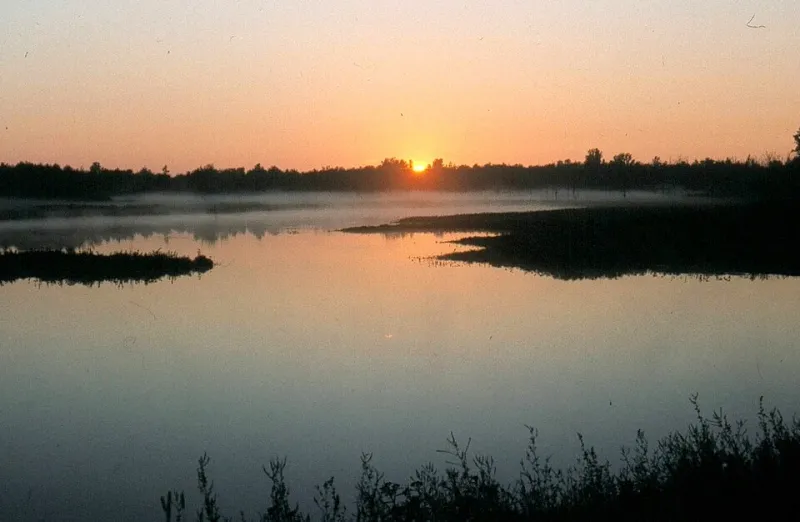
Photo: Department of the Interior. U.S. Fish and Wildlife Service. National Conservation Training Center. 10/1997-8888, Public domain, via Wikimedia Commons
There is a persistent cultural mythology in the United States that equates standing water with waste. For most of the nation's history, wetlands—marshes, bogs, fens, swamps, prairie potholes—were viewed as obstacles to productive land use, breeding grounds for disease, and impediments to agricultural and real estate development. Federal policy actively encouraged their conversion for much of the nineteenth and twentieth centuries, subsidizing the drainage of millions of acres in the name of progress.
What that mythology obscured, and what ecological science has spent decades methodically documenting, is that wetlands are among the most productive and carbon-dense ecosystems on Earth. They are not wastelands. They are, in the language of climate science, irreplaceable carbon sinks—and the United States has lost more than half of its original wetland area to conversion and degradation.
As the urgency of climate mitigation intensifies, that loss demands a fundamental reassessment.
The Carbon Mathematics of Wet Ground
To understand why wetlands matter so profoundly to climate stability, it helps to understand the basic biogeochemistry of waterlogged soils. In upland ecosystems—forests, grasslands, croplands—organic matter decomposes relatively rapidly when organisms die. Bacteria and fungi break down plant tissue, releasing carbon dioxide back into the atmosphere as part of a continuous cycle.
In wetlands, that cycle is interrupted. Saturated, oxygen-depleted soils dramatically slow microbial decomposition. Dead plant material accumulates layer upon layer, year after year, century after century, locking carbon into dense organic soils. In peatlands—a category of wetland found across northern Minnesota, Michigan, and the Appalachian highlands—this accumulation can extend meters deep, representing thousands of years of stored atmospheric carbon.
The numbers are striking. While temperate forests sequester roughly one to three tons of carbon per acre annually, coastal salt marshes and freshwater peatlands can sequester carbon at rates two to five times higher, according to research synthesized by the National Oceanic and Atmospheric Administration. More significantly, the carbon already stored in wetland soils represents stocks that, once released through drainage or disturbance, cannot be quickly recaptured.
When wetlands are drained, the organic soils are exposed to oxygen, and decomposition accelerates dramatically. A wetland that took millennia to accumulate its carbon stores can release a significant portion of them within years of drainage. This is not a theoretical risk—it is an observed phenomenon playing out across the Mississippi Delta, the Florida Everglades, and the drained agricultural peatlands of California's Sacramento-San Joaquin Delta, where subsiding land and carbon emissions are now measurable at the landscape scale.
A Map of Loss
The geographic pattern of wetland loss in the United States is not random. It tracks closely with the history of agricultural expansion and coastal development.
The Midwest's prairie pothole region—a mosaic of shallow wetlands stretching across the Dakotas, Minnesota, and Iowa—has lost an estimated 50 to 90 percent of its original wetland area to agricultural drainage, depending on the state. These wetlands were critical breeding habitat for migratory waterfowl and, as research has increasingly confirmed, significant contributors to regional carbon storage and water quality.
Along the Gulf Coast, Louisiana alone loses an estimated land mass equivalent to roughly a football field every 100 minutes to coastal erosion and subsidence—much of it former wetland that has been disconnected from the sediment supplies needed to sustain it. The consequences extend well beyond carbon: Louisiana's vanishing coastal marshes once buffered communities from hurricane storm surge, a function whose value became devastatingly apparent during Katrina in 2005.
In the Southeast, bottomland hardwood swamps along the Mississippi Alluvial Valley have been reduced by more than 75 percent from their historical extent, replaced primarily by row crops. The ecological services those forests provided—flood attenuation, water filtration, wildlife habitat, carbon storage—were never factored into the economic calculus of conversion.
Restoration as Climate Strategy
The recognition that wetland loss is a climate liability has catalyzed a growing restoration movement, and some of the results are offering compelling proof of concept.
In the Sacramento-San Joaquin Delta, the California Department of Water Resources and partner organizations have undertaken wetland restoration projects that have demonstrably reversed carbon emissions on converted peatlands. By re-flooding drained fields and reestablishing emergent marsh vegetation, these projects have transformed former carbon sources into carbon sinks—while simultaneously reducing land subsidence that threatens the region's freshwater infrastructure.
Along the Gulf Coast, the RESTORE Act—passed in the wake of the Deepwater Horizon disaster—has directed funding toward coastal wetland restoration across the five Gulf states. Projects in Louisiana's Barataria Basin have reintroduced sediment-laden river water to starved marshes, rebuilding land that had been disappearing for decades. Early monitoring data suggest meaningful gains in both marsh extent and carbon accumulation.
In the Midwest, partnerships between the US Fish and Wildlife Service, Ducks Unlimited, and private landowners through the Wetland Reserve Easement program have restored hundreds of thousands of acres of agricultural wetlands. Beyond carbon, these restored wetlands have measurably improved downstream water quality by intercepting agricultural runoff before it reaches rivers and lakes.
The Economics of Ecological Value
One of the persistent barriers to wetland protection has been the challenge of translating ecological services into economic terms legible to developers, landowners, and policymakers. That translation is becoming more sophisticated.
A 2020 analysis published in Nature Sustainability estimated that the ecosystem services provided by US wetlands—including carbon storage, flood control, water purification, and fisheries support—carry an economic value in the hundreds of billions of dollars annually. When coastal wetlands absorb storm surge, they reduce infrastructure damage that would otherwise cost communities and insurers enormous sums. When freshwater marshes filter agricultural runoff, they reduce the cost of treating drinking water downstream.
Carbon markets offer another emerging mechanism for capturing wetland value. Voluntary carbon offset programs now include protocols for wetland restoration, allowing landowners who restore drained wetlands to generate carbon credits. While the integrity of carbon markets remains a subject of legitimate debate, well-designed protocols focused on measurable, permanent carbon sequestration in wetland soils represent a plausible pathway for directing private capital toward restoration.
A Landscape Worth Defending
At Green String Institute, we believe that ecological literacy is inseparable from climate action. Wetlands have suffered in part because they have been misunderstood—characterized as unproductive, unhealthy, or simply in the way. The science assembled over the past several decades tells a radically different story.
These landscapes are doing work that no engineered system can replicate at scale or cost. They are filtering water, stabilizing shorelines, supporting biodiversity, and quietly absorbing carbon that would otherwise warm the atmosphere. They are, in every meaningful sense, infrastructure—infrastructure that predates human civilization and that we are only now beginning to value appropriately.
Protecting what remains and restoring what has been lost is not sentimentalism. It is one of the highest-return climate investments available to the United States, and it begins with changing the story we tell about standing water.