Rethinking the Building Block: How Carbon-Absorbing Concrete Could Reshape American Infrastructure
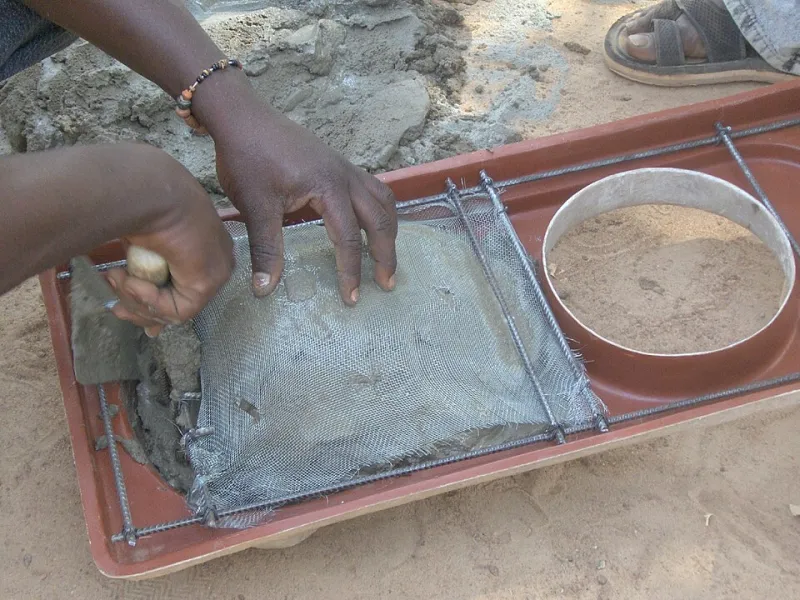
Photo: SuSanA Secretariat, CC BY 2.0, via Wikimedia Commons
Every highway overpass, every parking structure, every hospital foundation and apartment building core in America shares a common ingredient: concrete. It is so ubiquitous that it barely registers as a technology — more infrastructure than innovation, more background than foreground. Yet the production of Portland cement, concrete's essential binding agent, is responsible for approximately eight percent of global carbon dioxide emissions annually. That figure places the concrete industry alongside aviation and shipping as one of the harder-to-decarbonize sectors of the global economy.
What makes that statistic particularly striking — and, for researchers working in materials science, particularly motivating — is that concrete's carbon problem is not incidental to its chemistry. It is intrinsic. When limestone is heated to produce clinker, the foundational component of Portland cement, CO₂ is released both from the combustion of fuel and from the chemical decomposition of calcium carbonate itself. Roughly sixty percent of cement's emissions are process-based, meaning they cannot be eliminated simply by switching to renewable energy.
But the same chemistry that makes concrete a carbon emitter also makes it, under the right conditions, a potential carbon sink. And a growing cohort of scientists, startups, and infrastructure planners are working to exploit that potential at scale.
The Chemistry of Reversal
Concrete has always absorbed some carbon dioxide over its lifetime through a natural process called carbonation — atmospheric CO₂ slowly reacts with calcium hydroxide in hardened concrete to form calcium carbonate. The problem is that this passive process is slow, surface-limited, and captures only a fraction of the emissions generated during production.
The emerging field of carbon-mineralization technology is attempting to accelerate and amplify that chemistry deliberately. Rather than allowing CO₂ to diffuse slowly from the atmosphere, researchers are injecting concentrated carbon dioxide directly into concrete during the mixing or curing process — locking it into the material's crystalline matrix as a stable solid mineral.
CarbonCure Technologies, a Nova Scotia-based company with an expanding American presence, has deployed this approach across more than 400 concrete plants in the United States and Canada. Their system injects captured CO₂ — typically sourced from industrial processes — into wet concrete during mixing. The CO₂ reacts with calcium ions to form nano-sized calcium carbonate crystals that become permanently embedded in the mix. The result is concrete that has sequestered carbon and, as a secondary benefit, exhibits measurably improved compressive strength, allowing producers to use less cement per batch without sacrificing performance.
The company estimates that each cubic yard of concrete mixed with their system sequesters between five and ten kilograms of CO₂. Applied across the volume of concrete poured in the United States annually — approximately 500 million cubic yards — the cumulative potential is substantial.
Beyond Injection: Reimagining the Binder Itself
While CO₂ injection into conventional concrete represents an important near-term tool, a more radical set of innovations targets the cement binder itself.
Solida Technologies, a startup emerging from research at MIT, is developing a low-carbon cement formulation that replaces a significant portion of clinker with industrial byproducts — fly ash from coal combustion, slag from steel production — while incorporating a curing process that actively draws in atmospheric CO₂. Their approach belongs to a broader class of materials research known as supplementary cementitious materials (SCM) optimization, and it has attracted attention from the Department of Energy's ARPA-E program, which has funded several related projects under its initiative to develop carbon-negative construction materials.
Blue Planet Systems, based in Los Gatos, California, takes a different approach: manufacturing synthetic limestone aggregate from captured CO₂, which is then used in concrete formulations. Their process converts carbon dioxide — sourced from power plants or industrial facilities — into carbonate rock that functionally replaces the mined limestone aggregate that constitutes roughly 70 percent of conventional concrete by volume. In 2021, Blue Planet aggregate was used in a repaving project at San Francisco International Airport, marking one of the first large-scale deployments of carbon-negative aggregate in American infrastructure.
Pilot Projects and the Path to Scale
The gap between laboratory promise and infrastructure-scale deployment is rarely trivial in materials innovation, and carbon-sequestering concrete is no exception. Building codes, procurement standards, and structural engineering specifications were developed around the known performance characteristics of conventional Portland cement concrete. Demonstrating equivalent or superior performance — and earning the certifications that allow new materials to be specified in public projects — requires years of testing, documentation, and institutional negotiation.
Nevertheless, meaningful pilot projects are accumulating. In Colorado, the Department of Transportation has partnered with CarbonBuilt — a UCLA spinout whose technology uses a low-carbon cement blend cured in a CO₂-rich environment — to test carbon-negative concrete blocks in bridge infrastructure. In Texas, a commercial developer used CarbonCure-mixed concrete for a multi-story mixed-use building in Austin, with verified carbon accounting published as part of the project's sustainability documentation.
The federal government has begun to move as well. The Inflation Reduction Act included provisions directing the General Services Administration to procure low-embodied-carbon construction materials for federal building projects — a policy signal that, if consistently implemented, could reshape procurement patterns across hundreds of millions of square feet of public construction.
The Broader Significance for Sustainable Infrastructure
For those working at the intersection of environmental science and the built environment, carbon-negative concrete represents something more than an incremental efficiency gain. It suggests the possibility of construction as an active carbon management tool — infrastructure that, over its lifetime, contributes to atmospheric drawdown rather than loading.
That framing matters beyond the technical details. American infrastructure is entering a period of substantial replacement and expansion. The bridges, roads, transit systems, and buildings constructed or reconstructed over the next two decades will lock in embodied carbon — or lock in carbon sequestration — for fifty to a hundred years. The materials decisions made in the near term carry consequences that extend well past any individual project's lifespan.
The science supporting carbon-mineralizing concrete is sufficiently mature that the question is no longer primarily whether it works. The questions now are about cost parity, code adoption, supply chain development, and the policy frameworks that can accelerate deployment. Those are tractable problems — less a matter of scientific breakthrough than of institutional will and market design.
For a country that pours more concrete every year than almost any other nation on Earth, the stakes of getting those answers right are difficult to overstate.