When the Night Goes Dark No More: How Artificial Light Is Unraveling Wildlife's Internal Clocks
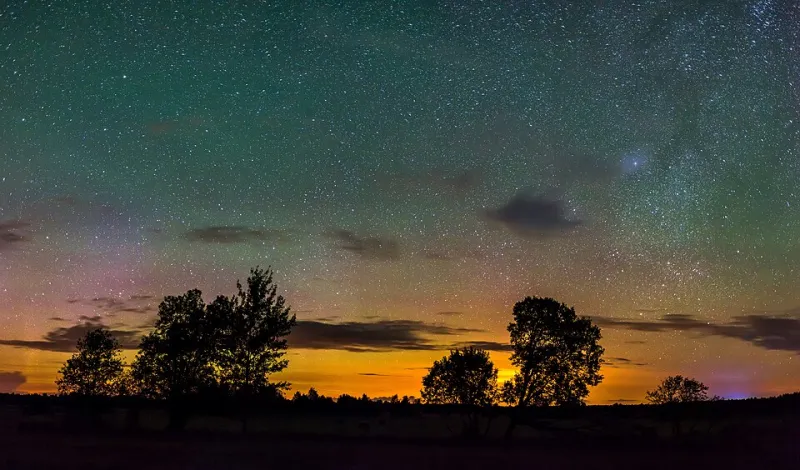
Photo: Kristian Pikner, CC BY-SA 4.0, via Wikimedia Commons
There is a particular kind of silence that settles over a healthy meadow after midnight—a silence that is, paradoxically, anything but quiet. Moths navigate between blossoms. Bats triangulate insects by echolocation. Fireflies pulse their bioluminescent courtship signals against the dark. These behaviors are not random. They are governed by finely calibrated internal clocks, synchronized over evolutionary time to the reliable rhythm of night following day.
That rhythm is now being overwritten.
Across the United States, artificial light at night—what scientists term ALAN—has expanded at a rate of roughly two percent per year for the past two decades. Satellite data published in the journal Science Advances documented that the artificially lit surface area of the Earth increased by approximately nine percent between 2012 and 2016 alone. The ecological consequences of this expansion are no longer speculative. They are being measured in disrupted migration corridors, collapsed pollinator populations, and the systematic erosion of the darkness that entire biological communities depend upon to function.
The Clock That Light Breaks
At the cellular level, nearly every organism on Earth—from bacteria to blue whales—maintains a circadian clock, an internal timekeeping system synchronized primarily by light. In vertebrates, specialized photoreceptive cells in the retina detect shifts in light intensity and wavelength and relay signals to the suprachiasmatic nucleus, a small cluster of neurons in the hypothalamus that orchestrates hormone release, metabolism, immune response, and behavioral timing.
Artificial light at night confuses this system by introducing a light signal at the precise moment the body expects darkness. The disruption is not merely behavioral. Research from institutions including the Max Planck Institute for Ornithology and, domestically, the Cornell Lab of Ornithology has demonstrated that chronic exposure to low-intensity artificial light suppresses melatonin production in birds, accelerates gonadal development, and triggers early-season migratory restlessness—a phenomenon called Zugunruhe—sometimes weeks before food resources and temperature conditions are appropriate for departure.
The consequences cascade. A bird that departs too early may arrive at a northern breeding ground before the insect emergence it depends upon for feeding its young. This mismatch—between organism timing and ecological resource availability—is one of the subtler but more destabilizing effects of a warming, brightening world.
Pollinators on the Wrong Schedule
The disruption is not confined to vertebrates. Nocturnal insects, which constitute a substantial and frequently overlooked share of North America's pollinator community, are among the most acutely affected organisms.
A landmark study published in Nature in 2017 found that artificial lighting reduced nocturnal insect visits to flowering plants by sixty-two percent in Swiss meadows. More recent work from researchers at the University of Exeter extended similar findings to populations of hawkmoths and noctuid moths across the United Kingdom and suggested comparable dynamics in North American species. Moth communities near urban light sources show altered foraging patterns, reduced reproductive success, and, over multiple generations, declining population density.
For plants that depend on nocturnal pollinators—and there are hundreds of native North American species that do, including evening primrose, moonflowers, and certain species of native cacti—the downstream effects include reduced seed set and diminished genetic diversity across populations.
The irony is considerable. Many of the ornamental lighting installations that Americans install to beautify their gardens and landscapes are, in ecological terms, functioning as traps that draw moths away from the very native plants those landscapes were designed to support.
Glass, Light, and the Flyway Problem
Migratory birds navigating North America's major flyways—the Atlantic, Mississippi, Central, and Pacific corridors—have long contended with habitat fragmentation and pesticide exposure. Artificial light has added a third dimension of hazard.
Research coordinated through the Fatal Light Awareness Program and supported by data from the Cornell Lab estimates that between 365 million and one billion birds die annually in the United States from building collisions, the majority of which involve glass. Light is a central driver of this mortality. Illuminated buildings during spring and fall migration attract birds, particularly songbirds traveling at night, into urban airspace where they become disoriented, circle illuminated facades, exhaust themselves, and ultimately collide with reflective surfaces.
Chicago's Lights Out program, one of the country's most established voluntary dark-sky initiatives for urban buildings, has demonstrated that extinguishing or dimming building lights during peak migration windows—typically two weeks in spring and two weeks in fall—produces measurable reductions in collision mortality. Similar programs now operate in New York City, Houston, and Washington, D.C., with preliminary data suggesting collision rates drop by as much as eighty percent in participating buildings.
The Dark Sky Movement Matures
What began as an astronomy-driven campaign to preserve clear views of the night sky has evolved into a sophisticated conservation framework with ecological science at its foundation. The International Dark-Sky Association, headquartered in Tucson, Arizona, now certifies Dark Sky Communities, Parks, and Reserves across the United States, establishing lighting ordinances and retrofit standards that balance human safety needs with ecological protection.
The science behind these certifications has grown considerably more precise. Researchers now understand that not all artificial light is equally disruptive. Short-wavelength blue and white light—common in LED streetlights adopted widely by American municipalities for their energy efficiency—is substantially more biologically disruptive than warm-toned amber or red-spectrum lighting. Blue light penetrates more deeply into biological tissues, suppresses melatonin more aggressively, and is more visible to the broadest range of wildlife species.
The practical implication is that switching from cool-white LEDs to warm-spectrum LEDs, reducing fixture brightness, shielding lights to direct illumination downward rather than outward, and installing motion-activated controls can dramatically reduce ecological harm while maintaining the safety and utility functions that justify nighttime lighting in the first place.
What Homeowners and Municipalities Can Do Tonight
The accessibility of dark sky interventions is one of the more encouraging dimensions of this issue. Unlike carbon sequestration or ocean plastic remediation, reducing light pollution requires no specialized equipment, no legislative mandate, and in many cases no additional expenditure. It requires, primarily, restraint.
For homeowners, the most impactful changes involve replacing outdoor fixtures with fully shielded, downward-directed units; selecting bulbs rated at 2700 Kelvin or below; installing timers or motion sensors to limit the duration of illumination; and turning off decorative lighting after midnight, when its human utility is minimal and its ecological cost remains constant.
Municipalities piloting dark sky retrofits—including Flagstaff, Arizona, which has maintained some of the country's strictest outdoor lighting ordinances for decades—report that well-designed warm-spectrum LED conversions can reduce energy consumption, lower municipal lighting budgets, and improve ecological outcomes simultaneously. The argument that darkness and safety are incompatible is increasingly difficult to sustain against the empirical record.
The Night as Ecological Infrastructure
At Green String Institute, we have written extensively about the ways in which apparently invisible systems—fungal networks below the soil, soundscapes within forest canopies, microbial communities in degraded farmland—function as critical ecological infrastructure. Darkness belongs in that category.
The night is not an absence. It is a structured environment, shaped by billions of years of evolution, within which entire communities of organisms have built their lives, their reproductive cycles, and their ecological relationships. When we flood it with light, we are not simply illuminating the landscape. We are dismantling a biological architecture that we do not yet fully understand and cannot easily reconstruct.
The research is clear enough to act on. The tools are available and affordable. What remains is the will to treat the night as something worth protecting—not merely as a backdrop for astronomy, but as a living system with its own integrity, its own inhabitants, and its own claim on our conservation attention.