Beneath the Canopy: How Underground Fungal Webs Are Redefining Forest Science and Climate Strategy
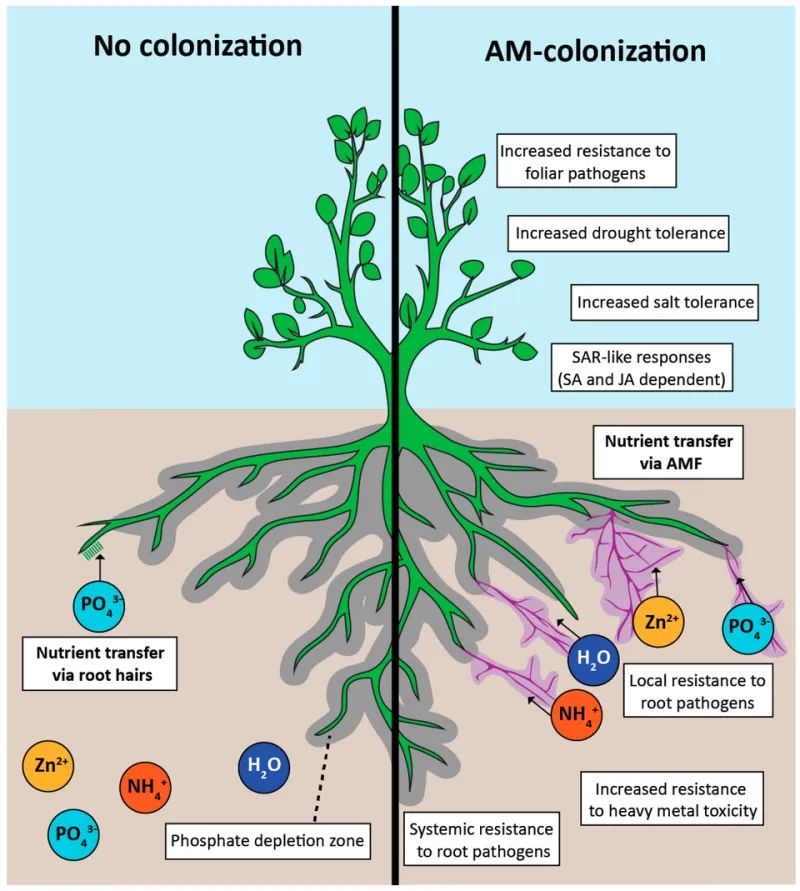
Photo: Catherine N. Jacott, Jeremy D. Murray and Christopher J. Ridout, CC BY-SA 4.0, via Wikimedia Commons
Walk through an old-growth forest in the Pacific Northwest, and the spectacle above ground — the towering Douglas firs, the cathedral light filtering through dense canopies — commands all of your attention. But the most consequential activity in that forest may be happening entirely out of sight, several inches below the surface of the soil, where an elaborate biological network hums with chemical traffic that rivals the complexity of any human communications system ever devised.
This is the world of mycorrhizal fungi: microscopic thread-like structures called hyphae that weave through soil and root tissue, stitching together individual trees into something that functions less like a collection of separate organisms and more like a single, distributed intelligence. The science examining these networks has advanced dramatically over the past two decades, and what researchers are finding carries profound implications — not only for how we understand forests, but for how we manage, restore, and design them in an era of accelerating climate disruption.
What Mycorrhizal Networks Actually Do
The term "mycorrhiza" derives from the Greek words for fungus and root, and the relationship it describes is among the oldest symbioses on Earth, dating back an estimated 450 million years. In exchange for sugars produced through photosynthesis, mycorrhizal fungi dramatically extend the effective reach of a plant's root system, accessing water and nutrients — particularly phosphorus and nitrogen — that roots alone could never obtain.
But the exchange is far more sophisticated than a simple barter arrangement. Research published over the past decade has demonstrated that mycorrhizal networks facilitate the transfer of carbon, water, and defense-signaling compounds between trees of the same and different species. A mature "mother tree" — a term popularized by University of British Columbia forest ecologist Suzanne Simard — can direct carbon resources through fungal threads toward younger seedlings growing in low-light conditions, effectively subsidizing the next generation of the forest.
When one tree in a network sustains insect damage or pathogen attack, it can transmit chemical warning signals through the fungal web to neighboring trees, which then upregulate their own defensive chemistry before any direct threat arrives. The forest, in this sense, is not a passive landscape but an actively communicating community.
Recent Research Breakthroughs
Scientific understanding of these networks has sharpened considerably in recent years, aided by advances in environmental DNA sequencing, isotopic tracing, and soil imaging technologies. A landmark 2023 study from researchers at Stanford and the University of Vermont mapped mycorrhizal connectivity across multiple forest types in the eastern United States, finding that network density and species diversity were strongly correlated with a forest's capacity to withstand drought stress — one of the most consequential pressures forests will face as climate change intensifies.
Separately, a research team at Oregon State University documented the role of mycorrhizal networks in post-disturbance recovery following wildfires in the Cascade Range. Forests with intact fungal infrastructure recovered measurably faster than those where soil disturbance — from heavy equipment during fire suppression efforts, for example — had disrupted the networks. The findings reinforced what many restoration ecologists had long suspected: that soil biology, not just the presence of seed sources, determines the trajectory of forest recovery.
Perhaps most strikingly, a 2022 global analysis published in Nature estimated that mycorrhizal fungi store approximately 13.12 gigatons of carbon annually — a figure that situates these organisms among the most significant carbon-sequestration mechanisms on the planet, comparable in scale to the carbon absorbed by global tree biomass itself.
Practical Applications for Land Management
For land managers, restoration ecologists, and urban planners across the United States, these findings are beginning to reshape practice in tangible ways. The traditional approach to reforestation — planting seedlings in cleared or degraded ground with minimal attention to soil biology — is increasingly recognized as insufficient. Restoring mycorrhizal infrastructure is now understood to be as important as restoring the tree species themselves.
Several forward-thinking forestry programs, including initiatives supported by the USDA Forest Service's National Forest System, have begun incorporating mycorrhizal inoculation into their reforestation protocols. Seedlings inoculated with appropriate fungal species prior to planting demonstrate significantly higher survival rates and growth performance, particularly in disturbed soils where native fungal communities have been depleted.
In urban contexts, the implications are equally significant. City trees are among the most stressed plants in any landscape — compacted soils, pollutant exposure, heat island effects, and isolation from natural soil communities all compromise their health and longevity. Urban forestry researchers at the University of Wisconsin-Madison and elsewhere are exploring how deliberate mycorrhizal inoculation and soil amendment strategies can extend the functional lifespan of street trees, improve stormwater absorption, and even enhance the carbon storage capacity of urban green infrastructure.
Landscape architects working on large-scale urban park projects in cities including Chicago, Seattle, and Atlanta are beginning to consult soil ecologists during the design phase — a collaboration that would have been unusual even a decade ago — to ensure that plant communities are assembled in ways that support robust fungal connectivity rather than inadvertently fragmenting it.
The Threat Landscape
Understanding what these networks do makes it correspondingly easier to understand what threatens them. Conventional agriculture, with its dependence on synthetic phosphorus fertilizers, is among the most significant. When plants receive abundant phosphorus through external application, they reduce their investment in mycorrhizal partnerships, effectively starving the fungal networks over time. Repeated tillage physically severs hyphal threads, preventing network reestablishment. The result, across millions of acres of American farmland, is soil biologically impoverished beyond what surface-level degradation indicators typically reveal.
Urban development practices compound the problem. Grading and compaction during construction eliminate the fungal communities that took decades or centuries to establish, and the ornamental plant palettes favored in conventional landscaping — often dominated by non-native species with no evolutionary relationship to local fungal communities — do little to support their recovery.
Fungicide use, both agricultural and residential, presents an additional and underappreciated risk. Research from the University of California Davis has documented that certain broad-spectrum fungicides applied to lawns and ornamental plantings suppress mycorrhizal fungi alongside their pathogenic targets, with cascading effects on plant health and soil carbon dynamics.
Designing With the Network in Mind
The emerging discipline of what some researchers call "mycologically informed" landscape design offers a more constructive path. At its core, the approach asks designers and managers to treat the soil fungal community as a primary design constraint — something to be preserved, enhanced, and deliberately built — rather than as an invisible backdrop.
Practically, this means minimizing soil disturbance during installation and maintenance, selecting plant species with documented mycorrhizal compatibility, avoiding synthetic phosphorus inputs in naturalistic plantings, and incorporating woody debris and leaf litter that sustain the fungal communities on which the entire system depends.
For restoration projects on degraded lands — former agricultural fields, post-industrial sites, areas recovering from invasive species removal — inoculation with locally sourced mycorrhizal consortia, combined with the establishment of nurse plants that can anchor early network development, is showing considerable promise in accelerating the return of functional soil ecology.
The science is still maturing. Much remains unknown about network dynamics across different forest types, climate zones, and disturbance histories. But the foundational insight — that forests are not collections of individual organisms competing in isolation, but deeply interconnected communities whose resilience depends on biological infrastructure we cannot see — is now well established. Designing landscapes and managing forests as though that insight matters may be among the most important practical steps American land stewardship can take in the decades ahead.