Breathing In the Synthetic World: What Researchers Are Finding in Human Lung Tissue
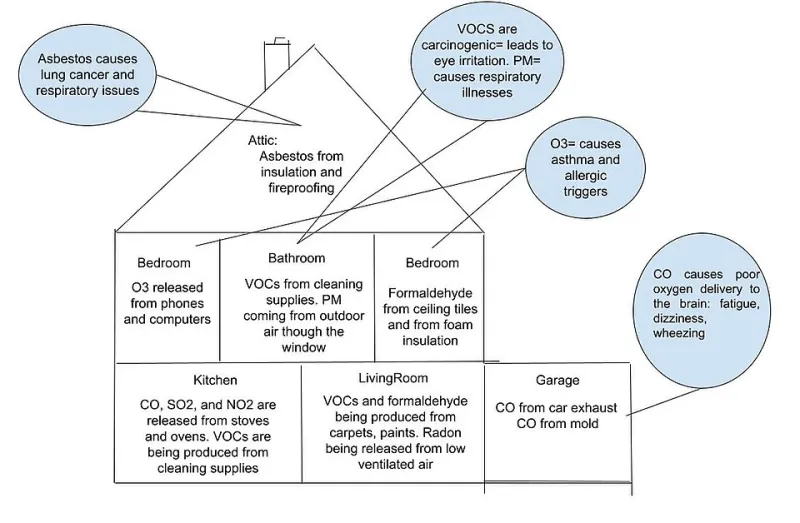
Photo: Sophia.Rother, CC BY-SA 4.0, via Wikimedia Commons
For decades, conversations about air pollution have centered on what exists beyond our walls—smog hanging over highways, particulate matter drifting from industrial smokestacks, wildfire haze rolling across western states. Yet a growing body of scientific evidence is redirecting attention inward, toward the spaces where Americans spend roughly 90 percent of their time. The air inside homes, offices, and schools is increasingly understood not as a refuge from outdoor contamination, but as its own distinct and underexamined pollution environment.
Among the most unsettling findings to emerge from this field is the presence of microplastic particles in human lung tissue. These are not trace detections at the margins of scientific sensitivity. Researchers have recovered fragments and fibers from deep within the lower lobes of lungs—regions the body's natural filtration systems were never engineered to protect, because evolution had no reason to anticipate a world saturated in synthetic polymers.
What the Research Is Telling Us
A landmark 2022 study published in the journal Science of the Total Environment analyzed lung tissue samples from surgical patients and identified microplastics in eleven of thirteen individuals examined. The particles recovered included polypropylene, polyethylene terephthalate (PET), and resin fragments—materials that correspond directly to common household and construction products. This was not an isolated result. Subsequent studies conducted across multiple countries have reinforced the finding, establishing that microplastic inhalation is not an occupational hazard confined to factory workers or industrial settings. It is a routine feature of contemporary domestic life.
The particles themselves arrive in indoor air through several mechanisms. Synthetic textiles—polyester upholstery, nylon carpeting, acrylic fleece blankets—shed microscopic fibers continuously through normal use, washing, and physical disturbance. Foam padding in sofas and mattresses degrades over time, releasing fragments as the polymer matrix breaks down. Vinyl flooring, plastic blinds, and certain wall paints contribute additional particles, particularly as these materials age and lose structural integrity under light exposure and temperature fluctuation.
Heating and cooling systems then perform an ironic function: designed to circulate and condition air, they also distribute these particles throughout interior spaces, suspending them in the breathing zone for extended periods.
The Health Implications Researchers Are Tracking
The full toxicological picture remains an active area of investigation, and scientists are careful to distinguish between what is established and what is still being characterized. What is clear is that the lungs respond to microplastic presence with inflammation. Tissue studies have documented immune cell activity around recovered particles, suggesting the body recognizes these materials as foreign and mounts a defensive response.
Of particular concern is the capacity of microplastic particles to carry chemical additives—flame retardants, plasticizers, UV stabilizers, and colorants—that were incorporated during manufacturing. These compounds do not remain inert once a particle is inhaled. Research into related contaminants suggests that some additives can leach from particles once deposited in biological tissue, introducing potential hormonal disruption and oxidative stress at the cellular level.
For populations already managing respiratory conditions—asthma, chronic obstructive pulmonary disease, or compromised immune function—the additional burden of microplastic exposure may compound existing vulnerabilities. Children, whose respiratory systems are still developing and who spend considerable time on floors where particle concentrations tend to be highest, represent another group warranting specific attention from researchers and public health agencies.
Tracing the Lifecycle Back to Its Source
Addressing microplastic inhalation effectively requires thinking about the problem at multiple scales simultaneously. At the most immediate level, individual households can take meaningful steps to reduce particle loads in their interior environments. Frequent vacuuming with HEPA-filtered equipment removes settled particles before they can be re-suspended. Increasing ventilation—opening windows when outdoor air quality permits, using air purifiers with fine-particulate filtration—reduces airborne concentrations. Choosing natural-fiber alternatives for textiles, where available and economically accessible, reduces the primary source of fiber shedding.
But individual action, while valuable, cannot substitute for upstream intervention in how materials are manufactured and regulated. The United States currently lacks comprehensive federal standards governing microplastic emissions from consumer products. The regulatory frameworks that govern outdoor air quality under the Clean Air Act have no direct parallel for the indoor environments where most exposure actually occurs. This represents a significant gap that environmental health advocates and sustainability researchers have increasingly identified as a policy priority.
The built environment itself offers a longer-term lever. Green building certification systems, including LEED and the Living Building Challenge, have begun incorporating indoor air quality metrics more rigorously into their frameworks. Specifying low-VOC and low-emission materials, avoiding PVC in interior applications, and selecting furnishings made from natural or certified-low-emission materials are practices that architects and developers can embed into project specifications. For the existing housing stock—which will constitute the majority of American homes for decades to come—retrofit strategies focused on ventilation improvement and material replacement during renovation cycles represent the most practical near-term pathway.
The Sustainability Connection That Often Goes Unnamed
The microplastic crisis in indoor air is, at its foundation, a consequence of the same material economy that has generated plastic pollution in oceans, soils, and freshwater systems. The polymer fragments settling in human lung tissue did not originate from a discrete industrial accident. They are the cumulative output of a manufacturing paradigm that has treated synthetic materials as infinitely preferable to natural alternatives, without adequately accounting for the full environmental and biological lifecycle of those materials.
At Green String Institute, we have consistently argued that sustainability science must follow the complete trajectory of materials—from extraction and production through use and degradation. Microplastics in lung tissue are what that complete trajectory looks like when it terminates inside a human body. They are not an anomaly to be managed at the margins of environmental policy. They are a signal that the interior environments Americans inhabit are as much in need of ecological reconsideration as the landscapes and waterways that have historically commanded greater attention.
The research is still developing, and definitive dose-response relationships for specific health outcomes remain to be established. But the precautionary logic that has guided responsible environmental policy in other domains applies here with equal force. We do not need to wait for complete certainty before beginning to reduce the synthetic burden in our homes, our schools, and our workplaces. The particles are already there. The question is whether our policy frameworks and material choices will begin to reflect that reality.