Grown, Not Made: The Fungal Building Material That Could Quietly Displace Styrofoam From American Homes
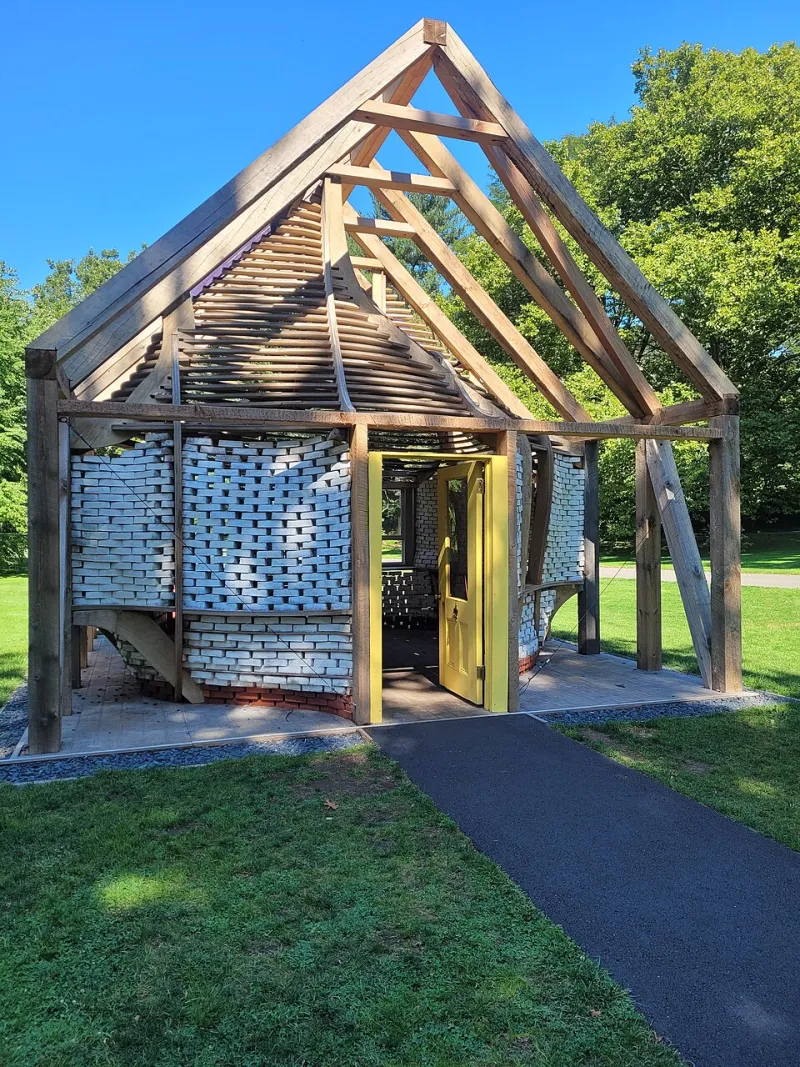
Photo: SnowFire, CC BY 4.0, via Wikimedia Commons
A Material That Grows Itself
Somewhere in an upstate New York facility, blocks of insulation are being harvested—not manufactured. They emerge from molds filled with agricultural byproducts: corn husks, hemp hurds, cottonseed hulls. What binds these loose materials into a rigid, lightweight composite is not a petrochemical adhesive but a living organism: Ganoderma or Pleurotus mycelium, the dense underground thread network of common fungi.
Over the course of five to seven days, the mycelium colonizes the substrate, threading through every gap and void. When the growth cycle is complete, the material is heat-treated to halt biological activity, leaving behind a structure that is firm, water-resistant, and—critically—entirely organic. No synthetic resins. No blowing agents. No persistent chemical residue. Just biology, doing what it has done for hundreds of millions of years.
This is the quiet premise of mycelium-based construction materials, a field that has moved with surprising speed from academic curiosity to commercial product, and that now stands at the threshold of something more consequential: a genuine challenge to the petrochemical foam products that insulate the majority of American homes.
What Conventional Insulation Actually Costs
Expanded polystyrene—EPS, commonly known as Styrofoam—and extruded polystyrene (XPS) dominate the American insulation market. Together with spray polyurethane foam, they represent billions of dollars in annual sales and a staggering environmental liability.
Polystyrene is derived from benzene and styrene, both petroleum products and recognized health hazards in occupational settings. Its production releases hydrofluorocarbons and other potent greenhouse gases. Once installed in a building, foam insulation is effectively permanent: it does not biodegrade on any meaningful human timescale, and it is rarely recyclable in practice. Demolition projects send enormous volumes of foam to landfills, where it fragments into microplastics that migrate into waterways and soils.
The building and construction sector accounts for roughly 40 percent of global energy consumption and a comparable share of carbon emissions. Material selection is not a peripheral concern—it is central to any serious decarbonization strategy. Researchers and architects who have spent years searching for alternatives to petroleum-derived foam are increasingly looking at what mycologists have understood for decades: fungal networks are among the most structurally sophisticated material systems in nature.
The Science Behind the Structure
Mycelium composites derive their mechanical properties from chitin, the same polysaccharide that gives insect exoskeletons and crustacean shells their resilience. Chitin fibers, when densely networked through a porous substrate, create a material with a strength-to-weight ratio that rivals or exceeds expanded polystyrene in compression resistance.
Independent testing has demonstrated that mycelium panels can achieve R-values—the standard American measure of thermal resistance—comparable to EPS at equivalent thicknesses, typically in the range of R-3 to R-4 per inch. They also exhibit meaningful acoustic dampening properties, an increasingly valued characteristic in dense urban residential construction.
Perhaps most significantly from an environmental standpoint, mycelium composites are fully compostable. A panel removed during renovation can be broken into a backyard compost pile and will decompose within months, returning its constituent elements to the soil. No landfill. No microplastic fragmentation. No residual toxicity.
Researchers at institutions including Rensselaer Polytechnic Institute and the State University of New York College of Environmental Science and Forestry have published peer-reviewed findings confirming these material properties, lending the field a scientific credibility that has attracted both private investment and federal research interest.
From Laboratory to Lumber Yard
The transition from research prototype to commercial product has been led most visibly by Ecovative Design, a company founded in Troy, New York, that has been producing mycelium composites at commercial scale since the early 2010s. Initially focused on packaging applications—replacing EPS in shipping containers for electronics and furniture—Ecovative and its licensees have progressively expanded into architectural applications, including wall panels, ceiling tiles, and structural insulation boards.
Smaller firms have followed. Companies in California, Oregon, and Massachusetts are now offering mycelium-based building products to architects and contractors, often positioning them for use in high-performance residential construction, passive house projects, and commercial interiors where embodied carbon accounting is becoming a client expectation rather than a specialty concern.
Some of the most visible early adopters have been institutional: museum installations, hospitality interiors, and demonstration housing projects funded through university sustainability programs. These applications have provided proof-of-concept evidence that mycelium panels can perform adequately in real-world conditions, resist moisture when properly detailed, and be installed using conventional carpentry tools without specialized training.
The Barriers That Remain
For all of its promise, mycelium insulation faces formidable obstacles before it can meaningfully displace petroleum foam in American residential construction.
Cost is the most immediate. Mycelium panels currently carry a price premium of 20 to 50 percent over comparable EPS products, reflecting the relatively small scale of production and the labor intensity of biological manufacturing. Until production volumes increase substantially, cost parity with conventional foam remains a medium-term aspiration rather than a present reality.
Building codes present a structural challenge of a different kind. The International Residential Code, adopted in some form by most US states, relies on tested and listed products for fire resistance, moisture management, and structural performance. Mycelium composites have not yet accumulated the full body of third-party testing data required for code compliance in all jurisdictions, creating approval uncertainty that makes risk-averse contractors reluctant to specify them.
Fire performance, in particular, requires careful attention. Organic materials must meet strict flame-spread and smoke-development requirements under American building codes. While mycelium composites have demonstrated fire resistance comparable to wood and superior to some foams in preliminary testing, comprehensive UL listings for wall assembly applications remain in progress for many products.
Moisture management in humid climates—the Gulf Coast, the Pacific Northwest, and the mid-Atlantic—demands further research. Mycelium is, by definition, a biological material, and while heat treatment halts active growth, the long-term behavior of chitin-based composites under sustained high-humidity conditions is an active area of investigation.
A Policy Landscape Beginning to Shift
The regulatory environment is not static. The Inflation Reduction Act of 2022 created new tax incentives for energy-efficient home construction and renovation, creating modest but real financial motivation for builders and homeowners to consider higher-performance insulation systems. Some state green building programs—notably California's Title 24 energy code and Massachusetts's stretch energy code—are pushing the performance envelope in ways that create openings for innovative materials.
Environmental product declarations, which quantify the embodied carbon of construction materials across their full lifecycle, are becoming standard expectations in institutional and commercial construction. Mycelium composites perform exceptionally well by this measure, often achieving carbon-negative status when agricultural waste substrates are used and when end-of-life composting is accounted for. As embodied carbon accounting spreads into residential construction, this advantage becomes increasingly legible to clients and designers.
What the Walls of Tomorrow Might Contain
The history of construction materials is, in part, a history of biological materials gradually displaced by industrial ones: timber giving way to steel, clay brick supplemented by concrete block, natural cork replaced by petroleum foam. Mycelium composites represent a potential reversal of that trajectory—a return to biologically derived materials, but one informed by contemporary materials science and ecological accounting.
The technology is not yet ready to insulate the average American home at a price point accessible to most builders. But the science is sound, the commercial infrastructure is developing, and the environmental case is compelling in a way that is difficult to dismiss. For researchers, architects, and builders who take seriously the material consequences of construction decisions, the fungal wall panel is no longer a curiosity. It is a direction.