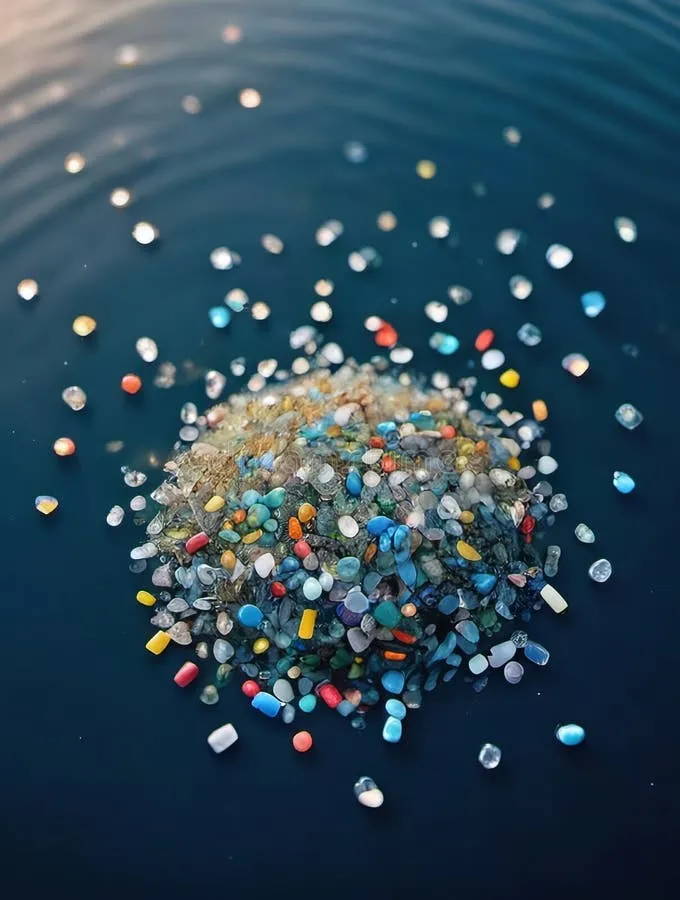
Every Spin Cycle Tells a Story: The Synthetic Fiber Crisis Unraveling in Our Oceans

Photo: Petar Milošević, CC BY-SA 4.0, via Wikimedia Commons
There is a ritual so ordinary it barely registers as an action: sorting laundry, loading the machine, pressing start. Yet researchers have spent the better part of a decade documenting what happens in those thirty to sixty minutes — a cascade of mechanical friction and water turbulence that liberates hundreds of thousands of microscopic plastic strands from fleece jackets, polyester activewear, and nylon blends. Those strands, each thinner than a human hair, travel through wastewater systems, survive treatment processes that were never designed to catch them, and ultimately disperse into rivers, estuaries, and oceans.
The numbers are staggering in their cumulative weight. A 2021 study published in PLOS ONE estimated that American households release approximately 878 tons of microfibers annually through residential laundry alone. Scaled globally, the figure climbs into the millions of tons. These are not abstract statistics. They are particles that marine biologists now recover from the digestive tracts of Pacific salmon, from sediment cores beneath the Great Lakes, and from the tissues of filter-feeding organisms that form the foundation of marine food webs.
What the Machine Actually Does
To understand the problem, it helps to understand the physics. Synthetic textiles — polyester, nylon, acrylic, and their blended derivatives — are composed of polymer chains extruded into fine filaments and woven or knitted into fabric. During a standard wash cycle, garments rub against themselves, the drum, and each other. Agitation loosens individual fibers at weak points in the weave, particularly in older or lower-quality garments. Hot water accelerates the process by softening polymer bonds. A single synthetic fleece jacket can shed more than 1.7 grams of microfibers per wash — a figure documented in foundational research by researchers at the University of California, Santa Barbara.
What exits the machine enters the municipal wastewater stream. Modern treatment plants, while sophisticated, were engineered primarily to remove biological contaminants and dissolved chemicals. Microfibers, ranging from 1 micrometer to 5 millimeters in length, pass through many filtration stages with troubling efficiency. Studies from the Environmental Protection Agency and independent research institutions suggest that even advanced treatment facilities allow between 1 and 40 percent of incoming microplastics to flow into receiving waterways. In rural communities relying on older infrastructure, those percentages rise further.
The Ocean as Accumulator
Once microfibers reach coastal and open-ocean environments, their behavior becomes ecologically complex. Unlike larger plastic debris, these particles do not float conspicuously on the surface. They suspend at varying depths, adsorb persistent organic pollutants and heavy metals from surrounding water, and enter the food chain when zooplankton, bivalves, and small fish ingest them alongside natural particulate matter.
Marine scientists working along the US Atlantic seaboard have documented microfiber concentrations in commercially harvested oysters and clams at rates that have prompted quiet concern among food safety researchers. The vectors are not hypothetical. Americans who consume seafood are, in measurable quantities, consuming synthetic polymer fragments — a reality that reframes laundry not as a domestic inconvenience but as a public health and ecological matter simultaneously.
The chemical dimension compounds the biological one. Synthetic fibers are manufactured with dyes, flame retardants, and finishing agents, some of which leach into aquatic environments as the fibers degrade. Endocrine-disrupting compounds associated with certain textile dyes have been identified in water samples downstream of wastewater discharge points, raising questions about cumulative exposure for both aquatic species and human populations.
Filtration Technologies: Promise and Limitation
The most direct engineering response to microfiber shedding involves capturing particles before they leave the home. Washing machine filters specifically designed to trap microplastics have entered the consumer market in recent years, with products such as the Filtrol and the Lint LUV-R demonstrating capture rates of 87 percent or higher in independent testing. Germany and France have moved toward regulatory requirements mandating microfiber filters in new washing machines, a policy shift that has yet to materialize in the United States.
Laundry bags designed to contain shedding — among them the Guppyfriend, developed by a German environmental nonprofit — offer a complementary approach. Garments placed inside these fine-mesh bags shed fewer fibers into the wash water, with studies suggesting reductions of up to 54 percent. The limitation is consumer adoption: these products require behavioral change and modest additional expenditure, barriers that historically slow uptake even among environmentally motivated households.
At the municipal scale, some water utilities have begun piloting membrane bioreactor systems and advanced sand filtration capable of removing microplastics at higher rates than conventional treatment. These upgrades carry significant capital costs, and federal infrastructure funding has not yet prioritized microplastic removal as a categorical investment area — a gap that advocates argue must be addressed in forthcoming EPA rulemaking.
An Industry That Has Moved Slowly
Perhaps the most consequential dimension of this issue is the one least visible to consumers: the fashion industry's measured pace in confronting its role. Major apparel manufacturers have known about microfiber shedding since at least 2011, when the first peer-reviewed studies linking synthetic laundry to marine microplastic contamination appeared in scientific literature. In the decade-plus since, voluntary industry commitments have been modest and largely unenforceable.
Some brands have experimented with tighter fabric weaves and longer filament lengths that reduce shedding, and a handful of technical outdoor apparel companies have invested in fiber engineering research. However, the dominant commercial logic of fast fashion — which prizes low production costs and high turnover — runs directly counter to the material investments required to manufacture genuinely low-shed textiles. Without regulatory pressure or binding industry standards, the incentive structure remains misaligned.
The Microfiber Consortium, a UK-based industry body with American brand members, has produced testing protocols and research frameworks, but critics note that participation is voluntary and that published timelines for meaningful product reformulation remain vague.
What Consumers and Communities Can Do Now
In the absence of comprehensive regulatory action, individual and community-level responses carry real weight. Washing synthetic garments in cold water and on shorter, gentler cycles measurably reduces fiber shedding. Washing full loads rather than partial ones decreases agitation per garment. Front-loading machines, which agitate clothes through tumbling rather than a central agitator, consistently produce lower microfiber counts than top-loading equivalents.
Purchasing natural fiber alternatives — organic cotton, linen, hemp, and responsibly sourced wool — removes synthetic garments from the equation entirely for certain wardrobe categories. Where synthetics are necessary for performance or cost reasons, choosing higher-quality, tightly woven fabrics extends garment life and reduces per-wash shedding.
Community-level advocacy aimed at municipal water utilities and state environmental agencies can accelerate the adoption of advanced filtration infrastructure. And consumer pressure on apparel brands — expressed through purchasing decisions, shareholder engagement, and direct communication — has historically moved corporate positions on environmental standards when sustained and coordinated.
The ocean does not distinguish between an intentional act of pollution and an inadvertent one. Every load of synthetic laundry is, in the current technological and regulatory landscape, a contribution to a contamination crisis that marine ecosystems are absorbing in ways science is only beginning to fully measure. The solutions exist. The question is whether the collective will — industrial, governmental, and individual — can be assembled quickly enough to matter.